Tuesday, June 21, 2011

Mystery Queen

Every once in a while a bee will fly in completely covered in neon yellow pollen.
I opened hive #1 today to find no sign of the queen cell. It is as if it had never existed. If the queen cell was a desperate attempt to requeen I will not know if it worked for 5 days after the disappearance of the queen cell, which is approximately how long it would take a virgin queen to mate and settle in to egg laying.
Everything I have read says that a queen cell on the edge of a comb is a swarm queen, but there is no way this colony is preparing to swarm. They just do not have the mass of bees it would take. Or they've gone completely of  the deep end.

I am very concerned that there is something wrong with this hive. I finally pulled a couple bars back to try and locate some brood or eggs and found a few cells with larva but the cells looked dry and all the cells that were capped around them were drone cells. If the queen is only laying drone eggs that is bad news.

I started this endeavor believing that the bees know best. But I am realizing that the cost of finding out if this is true is the possible loss of this hive. I guess I need to be O.K. with that or I need to seriously consider introducing a new queen.


This is a comb they began building a month ago and they have never finished it. This was my first clue that things may not be going right. They should be building comb like crazy for the impending nectar flow.

But for now I will wait a week to see if there is an increase in population and I will check then for more progress on the brood.
I have put in a syrup jar and a pollen patty to help things along.

If it doesn't look better by July 1st I will think about taking drastic measures by introducing a comb of brood from hive #2 so they can raise a queen if they need one.

Tuesday, June 14, 2011

Straight Comb in Top Bar Hive #2

Four weeks have gone by and Hive #2 has been busy building comb. They have filled up 10 bars with beautiful straight combs, so I feel confident in celebrating the fact that something I did was right.
The trouble is that I have done a couple things different than hive #1 and I will never really know which one or two things worked.
This is the early version of my new bar design. It has a deeper cardboard strip. I have since taken the hint when the bees chewed it down to suit themselves and trimmed them all from a 1/2" to a 1/4" deep. I was happy to see that the bees built supporting comb up to the wood bar. At first it seemed they were going to just build the comb on the edge of the cardboard strip, which would not be good as the comb became large and heavy with honey or brood.

I feel pretty good about recommending my new bar design though, because I have put a couple of the new bars into hive #1 and they are building straight comb on them, in spite of the fact that the comb next to the new bar is crooked.
The queen cell looks a little like the shell of a peanut
I am a little concerned about hive #1. They seem to have a new queen in the making and I don't really understand why. In theory they were left with a new healthy queen when the hive swarmed, twice.
I can only guess what is going on is that the queen they were left with did not get mated because of the really poor weather we have been having, or she was effected by the mite population.
I opened the hive yesterday to find only healthy bees- no wing deformities at all and a queen cell on the edge of the outermost comb that was not there last week. I will be keeping a very sharp eye on them.

Saturday, June 4, 2011

Mites in the Hive

I was very alarmed to find a drone scuttling around in the grass under the hive the other day. That in itself is not an unusual event. Drones are expendable and are often unceremoniously tipped out the door of the hive when more room/food/cells are needed.
These were full drone cells last week, now they are cleaned out and being used.I am watching to see what develops here. Drone cells are very attractive to mites, so drones are commonly higher in mite infestations.
What was alarming was the comparatively giant Varroa Mite that was hanging on the belly of the drone. Seriously, if that mite was on my belly it would be the size of a small cat!
I took these pictures and then went on the search for what to do.

Mite is circled, click to enlarge this photo

 I have found this series of videos from the Florida State University on bee diseases to be concise and exceptional in their information content. Every time I watch one I learn something new.

I found a few other up to date sources on the web that also confirmed that screened bottoms are the way to go. My hives already have screened bottoms.

The next thing to do, it seems, is to make some "grease patties".  Here is a recipe I adapted from a much larger recipe from the West Virginia University (go here for a pdf with more detailed direction on the type of salt and where to place patties). I cut the recipe down because I didn't need enough for 10 hives.
That's "wintergreen oil" last on the list

The sugar and salt encourage the bees to eat the pattie. The oil in it gets on the bee's hairs and makes it difficult to hold onto for the mites.

 It also has wintergreen oil in it which is supposed to upset the mites and cause them to run around, increasing the chances that they will fall off the bees and through the screened bottom, never to be seen again.  

Caution: do not add more wintergreen oil than this. It will cause the bees to attack and kill the queen because they will not be able to smell her. In this recipe, more is not better. Also do not follow older recipes which advocate antibiotics being added. New studies have shown this only harms the bees in the long run by making anything the antibiotic treats, resistant.

 
I didn't even try to stir this stuff with a spoon, it's just too stiff. I just squished it in my hands like play dough, scraping the bottom several times in the process.

Grease pattie the size of a small hamburger.

You can see the screened bottom of the hive here. I had a syrup feeder in the hive so I replaced the jar with the grease pattie and put one on the side for good measure.
Only time will tell if this is an effective method for my top bar hives.

I am keeping a close eye on them. I am on the fence about using anything stronger to deal with the mites. There are a few more organic methods to use. But the danger is in Fall when the bee population drops for winter and mite populations spike. I have heard several accounts of seemingly healthy hives suddenly being a dead pile of bees, and apparently this is the number one sign of a critical Varroa Mite infestation.
The livestock salt from the feed store is too coarse for the grease patties so you have to whurr it up in a blender.
 I am hoping that the mites only achieved a foothold in the first place because of the stress the hive was under from of the very wet spring/summer we are having, and that as the weather improves and the bees now are not so crowded (because they swarmed twice) they will become healthy enough overcome the mites again.
Drone next to the mite
 Apparently all hives have mites these days. But it's all about how many mites they have that determines the health of the hive.

Wednesday, May 25, 2011

Swarmapalooza!

Top bar hives are easy to open and check on. The bees just go about their business as usual.

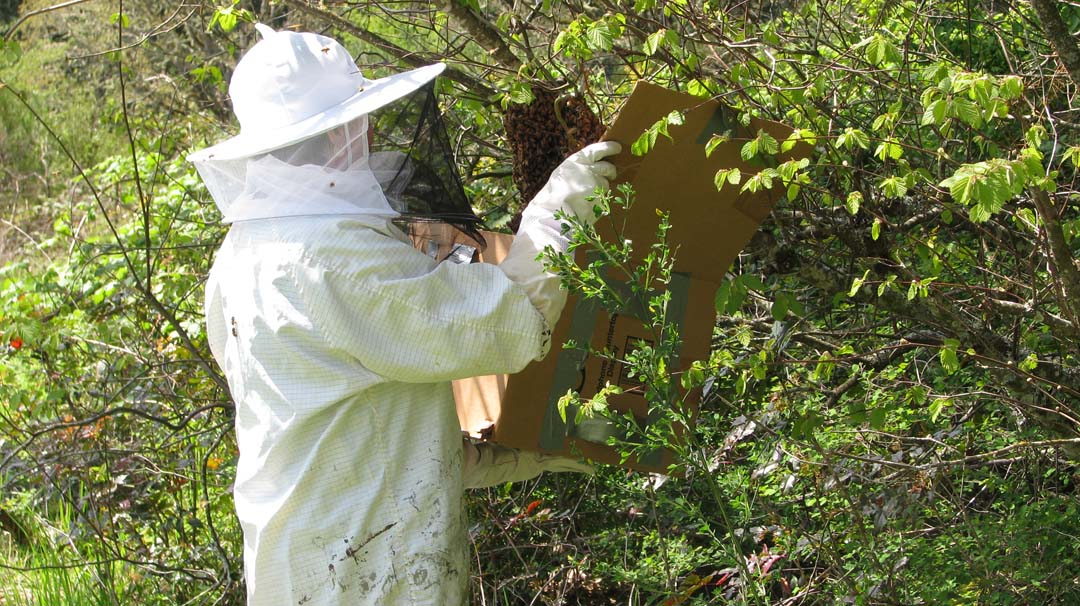
As I posted on Reluctant Homesteaders, I had a very easy time capturing my first swarm from top bar hive #1- The Women's Honey Cooperative. I just had to cut through about 50 little blackberry (We call them "Dew Berries" they crawl along the ground and sometimes up) vines since they chose to swarm about a foot above the ground onto a berry covered Scotch Broom bush. I posted this video of the capture and rehiving.

Then hive #1 swarmed again the next afternoon! I think it was because of the rainy weather we had the three preceding days.

The funny thing is that these bees originally came from a twin swarm that happened last June. Do twins run in bee families?
The second swarm was a breeze to catch. It was a lovely day. They landed on a small, eye level branch. Once they finished assembling (I called my brother in law who wanted a swarm, in the meanwhile) I just walked up with my already made, albeit leaky, Bee Box and shook them in.


 This was a defining moment. If I did not get the queen she would most likely fly off to another spot, taking all the bees with her. Here is a group bees that stayed on the branch after I shook the bulk of the swarm into my box. I watched them carefully in case I missed getting the queen. It turned out that they were just being attracted to the leftover scent of the queen. I knew this for sure because the bees in and on the box began "fanning" at the door a few minutes later.
Fanning is when the bees stand at the door and fan with their wings to send out pheromones to let everyone else know that the queen is inside. Soon all the bees in the air and in the small remaining cluster were making a traffic jam at the little door I had cut in the bee box. They all began to pile into the box.
It was a really nice swarm. About three pounds, we all guessed. That's about six or seven thousand bees (2500 to 3000 per pound). I did a little whining about how the swarm I had kept was smaller (about two pounds) and packed them up so that Buck could take them to meet our brother-in-law at the drop off point.

I topped up both Hive #1 and Hive #2 with syrup and a pollen pattie each, to make up for the smallish size of their numbers.

That way they could concentrate on raising brood in hive #1 and building comb for brood in hive #2.

And boy did they get busy in hive #2. I was very impressed with the speed with which they whipped together a full comb and three half combs in just 5 days!

The very best news is that the combs seem to be VERY STRAIGHT!!! I don't dare pull them up yet because of the new wax being very soft and I especially want them to keep moving on with their project of raising brood without interruption.
Hive #2 after 5 days
But I can see pretty well into the hive and the combs look pretty darn straight. Since that was my number one goal with this hive, I feel very relieved that my new style of bar is working.

I was more than a little nervous about that.
Top bars allow you to selectively look into the hive without disturbing the whole hive. Just lift a bar and peek in.
It feels good to be able to observe my bees and improve on their/our environment from those observations. I really think I am gaining so much more knowledge by having a top bar hive, if just by the simple fact that top bar hives can be opened so easily without sending the whole hive into a panic. I can just pick one bar up at a time and peek in, meanwhile all the rest of the bees just keep working away- they have no idea anything is different.
This makes it so that I can not only open the hive and see what they are up to, but I can pull up a chair on a nice day and just sit there watching them at work inside the hive. In fact, they seem to enjoy it when I have the hive open. Worker bees immediately begin using the opening on top to pack out those "team lift" jobs, like giant, dead drones.

I never even need to suit up for these impromptu observations, the bees could care less!

Friday, April 29, 2011

Wheather the Weather Will


Well, tick, tick, tick the time goes by as I wait eagerly for my hive to swarm so I can install the wanderlust section of my Women's Honey Cooperative into my bigger and better Top Bar hive. I haven't had time to put together all the photos and improvements for my post yet, but soon. The weather has been very wet punctuated by one or two shockingly sunny days and cold nights every 5 or 6 days. I'm baffled as to whether these guys will take a chance with this crazy weather.
But we are keeping our eyes on them - just in case.

Sunday, April 10, 2011

Giant Drones

April 10, 2011


My bees drawing up comb to hold the nectar that is soon to come.

I am amazed by the sudden burst of energy in the hive. Baby bees play in the front of the hive and giant drones are bumbling around begging for food from nurse bees. I think that there is definitely a difference in the size of the drones this year. I took some pics so you can see for yourself. The drones are HUGE!

Baby bee and giant drone

Friday, April 1, 2011

April Fools Joke?

April 1,
I had a mysterious occurrence in the hive recently. I opened the hive to see what the bees were up to and I found 3 of these drone pupae on the floor of the hive.


 I panicked and ask around, did a google search, all pointed to some deadly disease. But the next day I opened the hive and I found MICE in the hive. They had been walking up and down the floor of the hive eating off the bottoms of the combs (which is where the drones are usually laid).
I have caught 4 mice so far. They don't seem to have done a lot of damage. I must have caught them soon after they had found a way in.